Showing posts with label fintech. Show all posts

Saturday, February 15, 2020

BIS Update - Central Bank Digital Currencies

In the recent BIS (Bank for International Settlements) monthly update, they have several articles dealing with the status of central bank digital currencies. Below I have pasted in this recent update.

-------------------------------------------------------------------------------------------------


February 2020

The green swan 

How should central banks preserve financial stability in the age of climate change?

Central bank digital currencies survey 

Central banks are doing extensive work on digital currencies, and a small number indicate that they are likely to issue one soon.

Policy responses to fintech

FSI Insights paper provides a cross-country overview of policy responses to fintech developments.

Monetary policy frameworks

At an American Economic Association panel organised by the BIS, policymakers discuss whether monetary policy frameworks are still adequate to cope with the challenges central banks are currently facing.

Creating a credible and trusted digital currency

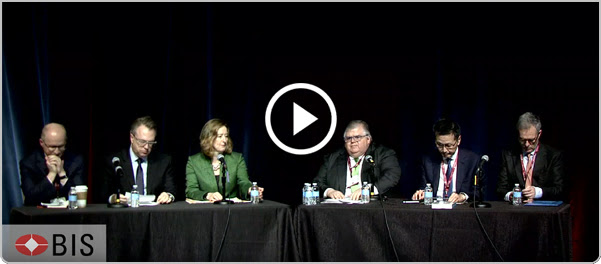
Benoît Cœuré takes part in a panel discussion on the likelihood of a trusted global digital currency and what trends could shape its future.
More BIS publications 

Statistics: Cross-border bank lending accelerates
Global cross-border bank lending grew by 9% year on year at end-September 2019.

Announcement: BIS expands membership
The BIS invites the central banks of Kuwait, Morocco and Vietnam to become members and increases emerging market representation in key committees.

Statistics: US dollar credit outside the US expands
Dollar credit to non-bank borrowers outside the US grew by 5% year on year at end-September 2019.

Friday, November 24, 2017

Fintech Innovation - Where is it Headed?

We have clearly entered into a new world in terms of financial technology that is slowly but surely altering the landscape of banking, payments systems, and even perhaps legal tender currencies. All this technological innovation is filled with buzzwords and companies trying to become "the next big thing" that changes the world in a truly meaningful way.


We have "Bitcoin", "Blockchain", "Distributed Ledger", "CBDC" (Central Bank Digital Currencies) as new buzzwords that have popped up in recent years. Lately we see even newer efforts to try and innovate to improve "blockchain" (see Hashgraph here). I believe there are now over 1,000 private "cryptocurrencies" vying for capital in the marketplace. 


Right now there is so much happening so quickly in terms of competing ideas and technologies, it can quickly become overwhelmingly confusing to most people who are not technological experts and just want a simple, inexpensive, and secure way to transact their business with a currency that holds it value over time. 


We have covered this topic pretty well here, but as it can be quite confusing and things keep changing constantly (funny how innovation works that way), I thought perhaps an analogy that most people can relate to might be helpful to see where things stand right now. With that in mind, let's use the old Sony Betamax vs. VHS technology battle as our guide. 

-------------------------------------------------------------------------------------------------------------------
Readers from my generation will quickly recall this technology battle. Younger readers might find it an interesting footnote in history that illustrates how there is a constant technological struggle to gain universal adoption that really never ends. Even in this case, after the VHS technology for video players won out in the marketplace, it was eventually replaced by DVD's, then Blue Ray etc. But perhaps this process can help us understand the ongoing technology battles in the fintech arena?

First, here is how the Betamax vs. VHS battle played out as described in this wikipedia article on the topic:
--------------------------------------------------------------------------------------------------------------

Videotape format war

"The first video cassette recorder (VCR) to become available was the U-matic system, released in September 1971. U-matic was designed for commercial or professional television production use, and was not affordable or user-friendly for home videos or home movies. The first consumer-grade VCR to be released was the Philips N1500 VCR format in 1972, followed in 1975 by Sony's Betamax. This was quickly followed by the competing VHS format from JVC, and later by Video 2000from Philips. Subsequently, the Betamax–VHS format war began in earnest. Other competitors, such as the Avco Cartrivision, Sanyo's V-Cord and Matsushita's "Great Time Machine" quickly disappeared.
Sony had demonstrated a prototype videotape recording system it called "Beta" to the other electronics manufacturers in 1974, and expected that they would back a single format for the good of all. But JVC in particular decided to go with its own format, despite Sony's appeal to the Japanese Ministry of Trade and Industry, thus beginning the format war."
. . . .
"Sony had met with Matsushita executives in late 1974 or early 1975 to discuss the forthcoming home video market.[6] Both had previously cooperated in the development and marketing of the U-Matic video cassette format. Sony brought along a Betamax prototype for Matsushita's engineers to evaluate. Sony at the time was unaware of JVC's work. At a later meeting, Matsushita, with JVC management in attendance, showed Sony a VHS prototype, and advised them it was not too late to embrace VHS "for the good of the industry" but Sony management felt it was too close to Betamax production to compromise."

Outcome


"The main determining factor between Betamax and VHS was the cost of the recorders and recording time. Betamax is, in theory, a superior recording format over VHS due to resolution (250 lines vs. 240 lines), slightly superior sound, and a more stable image; Betamax recorders were also of higher quality construction. But these differences were negligible to consumers, and thus did not justify either the extra cost of a Betamax VCR (which was often significantly more expensive than a VHS equivalent) or Betamax's shorter recording time.

JVC, which designed the VHS technology, licensed it to any manufacturer that was interested. The manufacturers then competed against each other for sales, resulting in lower prices to the consumer. Sony was the only manufacturer of Betamax initially and so was not pressured to reduce prices. Only in the early 1980s did Sony decide to license Betamax to other manufacturers, such as Toshiba and Sanyo.

Sony's decision in 1975 to limit Betamax's maximum recording time to one hour (for NTSC systems) handicapped its chances of winning this marketing war. VHS's recording time at first release (1976) was two hours—meaning that most feature films could be recorded without a tape change. It was not until the early 1980s that Betamax offered recording times comparable to VHS. In UK, the L-750 Betamax tape lasted 3 hours and 15 mins, while VHS was limited to a 3-hour maximum (The E-180), though later on an E-240 tape lasting four hours became available, though picture quality wasn't as good.

By the time Sony made these changes to their strategy, VHS dominated the market, with Betamax relegated to a niche position."

--------------------------------------------------------------------------------------------------------------------

So, how can we relate this old technology battle to what we see going on in Fintech today? I think in a number of ways. 

 As with most technology battles, what is being sought is a universal standard that everyone can easily use and will want to use. Before a universal standard is adopted for anything, there are usually competing versions of new technology vying to become the universal standard. Once most manufacturers pick what they want, one technology tends to "win out" and become what everyone adopts. Sometimes it matters less which technology is actually "superior" than it does which one gets adopted by the most manufacturers. Once a critical mass of adoption takes place, the standard become accepted across the board.
Applying this idea to the new banking and currency technologies we see just about everywhere now, I think we are in the process of seeing which innovative technology will gain the broadest adoption by the key "manufacturers" in this arena. In this analogy, I think the major banks and central banks are the "manufacturers" because whatever most of them adopt is more likely to become the global "standard".  The general public (as always) will have the final say because whatever end "financial product" is adopted will have to meet the needs of the end users (we, the people). 

It is important to distinguish between the underlying ledger technology that is used to support a currency system and payments system (blockchain and hashgraph for example) and the actual currency unit itself. As an example, one new Fintech innovation just introduced (Glint) does not use blockchain at all, but does hope to re-introduce the idea of gold as a currency people can use in daily transactions. Ben Davies of Glint has this to say about the ledger system they are using:

"One way we did it was to create our own ledger systems using micro-services architecture. It was about taking cutting edge technology and integrating into financial services. The innovation is in the application of that technology.”


Right now what we are seeing is that the major banks and central banks around the world are looking at which underlying supporting technology (like blockchain, hashgraph, various hybrids, etc) works the best in real world testing. 
Until we can get to a universal standard for this kind of underlying ledger technology, it is not really possible for central banks to move forward with the concept of central bank digital currencies. The currencies themselves are not really the innovation. They are just another electronic version of the legal tender currencies they already produce now. 
What is needed is an underlying ledger system that makes it possible to implement a digital version of their currency that is inexpensive, fast, and secureIt also needs to be "interoperable" (connect to) other banks and central banks existing systems (Bitcoin running on very slow blockchain ledger technology cannot do this and will remain a private virtual currency).
The first technology that central banks can adopt that meets these goals will likely "win out" and gain widespread global adoption in the existing banking system. At that point in time, it becomes more realistic to think in terms of a new "global digital currency" that can utilize whatever new underlying ledger technology eventually gains adoption as the universal standard. Just as VHS became the standard for video players, some new underlying ledger technology will likely do the same in the banking system.

Conclusion
I see the process above as playing out over time in stages. I believe right now we are in the middle of the technology battle for universal adoption of an underlying ledger system that all banks and central banks can plug into. Until that stage is completed, I would expect most central banks (and the IMF) to hold off on moving towards so called central bank digital currencies. I would expect a few central banks to step into the central bank digital currency waters first on test basis using what they believe will become the universal underlying ledger technology that all banks can plug into relatively easily (I am watching Singapore in 2018 for now). 
If and when these initial tests prove successful and the general public finds it attractive, I would then expect to see more and more central banks join in around the world further cementing the technology chosen as the "universal standard" that everyone can plug into. After all that, it would not surprise me to see the IMF look more seriously into the concept of an "IMF Coin" as they mentioned recently
This seems to me like the logical way for things to progress over time and why I have said I expect this process to take some time to unfold. What is sometimes overlooked is that it always takes more time than many expect to test out various concepts in the real world and make sure they will actually work and truly meet the end objectives of the final end users. In this case, the final end users would be the general public which will have the final say on what they prefer to use. I
I view that as a good thing. The final product (for a new official global reserve currency) will have to be easy to use, safe, and inexpensive. Any such currency will need to be able to demonstrate it can hold its value over time and retain the public confidence. If legal tender currencies fail in that regard, people will look elsewhere (perhaps to new gold payment systems or virtual currencies like Bitcoin). These days, there are more of choices available for people to consider. That also helps keep the system more honest. If people have real choices, then you must offer them a genuine product that meets their needs and has their confidence or they will opt out to another choice one way or another.

Meanwhile, innovation moves forward as it always does and we wait to see what emerges as the universal standard (or if one actually does emerge). 

Thursday, November 16, 2017

IMF: Fintech and Cross Border Payments

We have covered quite a bit of fintech news lately because that topic has emerged as the most likely to impact the overall monetary system whether because of private virtual currencies challenging the various legal tender currencies around the world or because a number of central banks are looking at implementing some kind of central bank digitial currency (CBDC).


The IMF has made it clear that they are also following all this closely to see where things may be headed. Here we have a recent speech by IMF Deputy Director Dong He on the topic of Fintech and Cross Border Payments. Below are a few excerpts.

--------------------------------------------------------------------------------------------------------------

"It’s a pleasure to join you here today, at Ripple’s “Central Bank Summit,” as we explore some of the key issues facing central banks raised by the current acceleration of progress in “fintech.”
The IMF has been carefully studying the trends in fintech, and my colleagues and I have gathered some initial thoughts about the way that the financial realm is likely to change. We’ve also been weighing how financial regulation and central banking will need to respond."
. . . . 
"In my remarks here today—focusing on implications of fintech for cross-border payments, I'll explore three broad areas:
  • First, a sketch of the economic framework on how fintech applications will affect financial services and the market structure.
  • Second, the current landscape of cross-border payments, and the possible evolution of cross-border payment systems; and
  • Third, the role of central banks, themselves, and the possible reasons for them to issue their own digital currencies."
..........
Central Bank Digital Currencies
"Let me now turn to a second possible avenue for DLT application to be used as a means of payment: Central banks could offer their own digital currencies.
A “Central Bank Digital Currency—let’s call it, in shorthand, a “CBDC”—would not be a parallel currency. It would merely be a digital form of central bank money that can be exchanged in a decentralized manner. In other words, it can be transferred or exchanged peer-to-peer, directly from payer to payee without the need for an intermediary.
Such a CBDC would be exchanged at par with the central bank’s other liabilities (its cash and reserves)—either through banks or directly at the central bank."
Why Issue a Central Bank Digital Currency?
. . . . . . 
-----------------------------------------------------------------------------------------------------------------
My added comments: I publish this kind of information not only to give readers a look at what the IMF and others are saying on these issues, but also to try and illustrate how these changes are unfolding very gradually and the outcome is by no means certain or predetermined. I see a lot of speculation that "China is about to replace the US dollar with a gold backed yuan" or "China will endorse a gold backed SDR to replace the US dollar" all the time. Many articles suggest that these kinds of major changes to the existing monetary system are about to happen any time now. 
Of course, I can't possibly know for sure what is going to happen in the future or when something major might change in the global monetary system. We have listed many potential triggers for that kind of change that really do exist and are pretty much present all the time despite the fact that no such changes have taken place so far. 
Also, there is no doubt that both Russia and China (and probably a number of other nations) are working towards the day when the US dollar does not hold its place at the primary global reserve currency. We see obvious proof of this all the time in both statements of officials and actions taken by those officials in those nations.
However, if you take the time to read what the various central banks, the IMF, and the BIS have released publicly on all this, you do not see any indication at all that they are moving rapidly to towards any major changes in the current monetary system dominated by the US dollar as global reserve currency. 
There is a lot of talk, a lot of studies, and a lot of various new technologies being introduced and tested that could lead to some big changes, but none of them appear to be leading towards a major global change in the near future as best I can tell. It feels like a universal technology standard formed by consensus (of the banks and central banks) needs to emerge first and we seem to be in the process of working through that now with a variety of concepts being tested. I view it as somewhat like the old BetaMax vs. VHS battle for standard universal adoption for video players back in the day (more on that in an article next week).
It appears that a slow and steady gradual movement towards change is underway driven by innovative new technologies. But the process will probably take some time to unfold at the current pace without some kind of major trigger (like a global crisis that took out the current monetary system). The best evidence I have from what I consider to be excellent and very high credibility sources is that we might expect to see a few central banks test out a central bank digital currency by next year. If that goes well, then others may follow and some of the bigger central banks might be tempted to test that out as well. If it does not go well, expect major central banks to be very cautious about making any big changes. My guess is that the IMF will sit back and watch all this to see how things turn out and which technology gains consensus widescale adoption in the banking system (or if any of the new technologies are able to obtain that status).
While I can't be sure what China and/or Russia might do of course, I don't expect them to try and force some kind major change to the existing global monetary system before all parties who would have to be involved in that are ready to agree on that. I don't find any public evidence that anything like that is anywhere on the near horizon despite articles I see constantly that speculate along those lines. The US seems to view efforts to undermine the US dollar globally somewhat along the same lines as a declaration of war (here is an alternative media view on that idea). I always remain open to evidence to the contrary should it arise.
As always, an unexpected crisis event can change things quickly. The most probable known event that could be in that category would be if the US is unable to resolve its problems with North Korea without a major shooting war taking place (Jim Rickards latest analysis is still 70% chance for war). The could certainly be a trigger for a major disruption of the current monetary system so we will continue to monitor that situation until it is resolved one way or another. (added note - see Jim Rickards Twitter comment on North Korea here)
By mid 2018, I feel like it will be pretty clear if any of this will lead to the kind of major monetary system change we watch for here and if further regular articles are really needed. It may be that I can just go into "monitor" mode and only produce an article if something that is significant in terms of monetary change surfaces. 

Monday, November 6, 2017

CNBC: Singapore to Finish Cryptocurrency Trial in 2018

Earlier this year we mentioned that we might see the first central bank digital currency arrive by next year. We also speculated it might come from Singapore. CNBC confirms in this article that Singapore intends to finish up its testing for such a currency in 2018. Below are a few excerpts from the article.

--------------------------------------------------------------------------------------------------------------------
"Singapore will conclude its experiment with blockchain technology and its own digital currency next year before deciding whether to commercialize the trial, the country's regulator has told CNBC.
In 2016, the Monetary Authority of Singapore (MAS) announced "Project Ubin," an exploration of blockchain or distributed ledger technology.
The project is split into five phases. The first, which looked at establishing a proof-of-concept design to conduct inter-bank payments using blockchain technology, was completed earlier this year. The second phase, which finished earlier this month, saw the development of three different models for inter-bank payments using blockchain.
Now, the MAS trial is looking at    . . . . . . "      click here to read the full CNBC article
---------------------------------------------------------------------------------------------------------------
My added comments: Here we have confirmation of something we have been reporting here for some time. At this point, it is too early to tell if Singapore will issue the first central bank digital currency since other countries (like China) are also looking at the idea. However, it is clear that Singapore has established itself as a leader in exploring innovative Fintech solutions and is moving towards some kind of decision in 2018.
One thing to note here is how slowly these things move. This is why when I see articles proclaiming that some kind of new central bank digital currency is "imminent", I take it with a grain of salt. There is no doubt that many central banks around the world are thinking about the idea. However, when you look at what they have said publicly, they tend to hedge on whether or not they will really move forward with it. I suspect that many central banks want to wait and see how the first early adopter central bank digital currencies work in the real world before moving ahead. This is why what happens in Singapore may be a good indicator for how the idea is accepted more globally.
-------------------------------------------------------------------------------------------------------------------
Added note: Singapore also continues to struggle with how to deal with private digital currencies like Bitcoin. This article talks about that.

Monday, October 30, 2017

David Lipton (IMF) - The Challenges to Sustaining the Global Recovery

In this recent speech, IMF Deputy Managing Director David Lipton talks about a variety of issues that will impact the financial landscape in the future. Below is an excerpt from this speech in regards to how Fintech may impact things.

------------------------------------------------------------------------------------------------------------------

. . . . 
Digital Finance
"All of which leads us directly to the third area of change: the broader universe of digital finance, which you will be discussing this afternoon. This is playing out right now before our eyes in the online payments platforms like PayPal and China’s Ali-Pay. In only a few years, many people in China’s cities have stopped using cash altogether. In East Africa, the online banking pioneered by M-Pesa has benefited millions of people who previously lived outside the financial system.
These success stories show how Fintech can be a force for inclusion and development.
But Fintech also presents a serious challenge to traditional banking models. And as online platforms develop lending and investment products, effectively acting like banks, every regulator and supervisor must be concerned with whether the current regulatory framework is adequately encompassing these businesses. Here, too, work is underway, with Fintech firms interacting with regulatory authorities on a range of possible solutions.
But we are still talking about a business that fits broadly within our frame of reference for financial services. A case can be made that next level of this digital transformation—the emergence of crypto-currencies, and new transaction and settlement technologies—is moving well beyond familiar boundaries.
The so-called distributed ledger technology is dispensing with the backroom and moving to instantaneous transactions outside the reach of governments—and that includes the scope of monetary policy. We now see central bankers starting to talk about issuing their own virtual currencies and considering ways of regulating the bitcoins and others.
Here, too, the implications are enormous. National regulators and international standard-setters need to move quickly to define a regulatory setting that can address the issues that will emerge almost before we know it. At the same time, we cannot “throw out the baby with the bathwater” by imposing a regime that stifles innovation.
The Fund has just begun to address these issues within its mandate. Like cyber-threats, there is a great deal of work to do to understand the potential macroeconomic impact."
------------------------------------------------------------------------------------------------------------------
Added note: The speech also mentions how debt continues to grow globally. This article in Reuters points out the problem with some big numbers.

Thursday, October 5, 2017

Christine Lagarde - IMF Should Be Open to Considering a Digital Version of the SDR

In this new speech at the Bank of England in London, IMF Director Christine Lagarde asks the audience to fast forward to the year 2040 to see what the world of central banking might look like. Interestingly, most everything she talks about in this future look has been covered here on this blog for some time. Below are some excerpts and then a few added comments.

----------------------------------------------------------------------------------------------------------

. . . . 

"And much has changed for the bankers and policymakers here in the City of London. But that is only the beginning. Let us spin the hands ofBig Ben forward to 2040 to catch a glimpse of their world. We might see that:
· Cars have disappeared, because people are moving about in hovering drones, or “pods,” which elegantly avoid each other in the morning rush hour.
· One of those pods carries the central bank governor, who recently started her second term. As part of her morning routine, she swipes through a hologram of news videos curated by a digital assistant, before arriving at Threadneedle Street.
· The governor disembarks, walks up to the columned façade, opens the door and…
Who will she encounter inside the building? Are there economists sitting at desks, debating policy choices around a table? Or is there an intelligent machine making decisions, setting rates, and issuing money?
In other words, how will fintech change central banking over the next generation? That is the focus of my remarks today."
. . . . 
"Let us start with virtual currencies. To be clear, this is not about digital payments in existing currencies—through Paypal and other “e-money” providers such as Alipay in China, or M-Pesa in Kenya.
Virtual currencies are in a different category, because they provide their own unit of account and payment systems. These systems allow for peer-to-peer transactions without central clearinghouses, without central banks.
For now, virtual currencies such as Bitcoin pose little or no challenge to the existing order of fiat currencies and central banks. Why? Because they are too volatile, too risky, too energy intensive, and because the underlying technologies are not yet scalable. Many are too opaque for regulators; and some have been hacked.
But many of these are technological challenges that could be addressed over time. Not so long ago, some experts argued that personal computers would never be adopted, and that tablets would only be used as expensive coffee trays. So I think it may not be wise to dismiss virtual currencies."
. . . . 
"So in many ways, virtual currencies might just give existing currencies and monetary policy a run for their money. The best response by central bankers is to continue running effective monetary policy, while being open to fresh ideas and new demands, as economies evolve."
. . . . 
"Instead, citizens may one day prefer virtual currencies, since they potentially offer the same cost and convenience as cash—no settlement risks, no clearing delays, no central registration, no intermediary to check accounts and identities. If privately issued virtual currencies remain risky and unstable, citizens may even call on central banks to provide digital forms of legal tender."
. . . . 
Cooperation is key
"To make things smoother—at least a bit—we need dialogue. Between experienced regulators and those regulators that are just beginning to tackle fintech. Between policymakers, investors, and financial services firms. And between countries.
Reaching across borders will be critical as the focus of regulation widens—from national entities to borderless activities, from your local bank branch to quantum-encrypted global transactions.
Because of our global membership of 189 countries, the IMF is an ideal platform for these discussions. Technology knows no borders: what is home, what is host? How can we avoid regulatory arbitrage and a race to the bottom? This is about the IMF’s mandate for economic and financial stability, and the safety of our global payments and financial infrastructure.
The stakes—and gains—from cooperation are high. We want no holes in the global financial safety net, however much it gets stretched and reshaped.
I am convinced that the IMF has a strong role to play in this respect. But the Fund will also have to be open to change, from bringing new parties to the table, to considering a role for a digital version of the SDR.
In other words, the IMF is in for the pod-ride."
. . . . 
Conclusion
As our pod journey comes to an end, some of you may wonder about my upbeat tone. For many, this new world of central banking is less Mary Poppins, and more Aldous Huxley: a “brave new world,” much like the one described in Huxley’s famous novel.
I believe that we—as individuals and communities—have the capacity to shape a technological and economic future that works for all. We have a responsibility to make this work.
That is why I prefer Shakespeare’s evocation of the brave new world in The Tempest: “ O wonder! How many goodly creatures are there here! How beauteous mankind is! O brave new world .” 
------------------------------------------------------------------------------------------------------------
My added comments: It's interesting to see Director Lagarde talking about the future of virtual currencies in ways similar to what we have talked about here. When we first wrote about this concept (a central bank or IMF digital currency everyone could own), it seemed like there was not much talk about it anywhere else that I could find. But now we see it pretty much everywhere. While it sounded very strange at first, perhaps it will turn out like things we saw on the original Star Trek TV series a long time ago and assumed were just figments of some writer's imagination and would never really show up in the real world. Director Lagarde mentions the year 2040 in her speech.


Image result for star trek hand walkie talkie


I am pretty sure that the one paragraph in this speech that will get a lot of attention is this one:
"I am convinced that the IMF has a strong role to play in this respect. But the Fund will also have to be open to change, from bringing new parties to the table, to considering a role for a digital version of the SDR."  (bold emphasis and underline is mine)
And we have talked about this very thing here for a long time. We have even pointed out that in order for the SDR to be used in this way in the future, the IMF will have to approve changes in the status quo (Director Lagarde says "be open to change").
While many will leap on this to assume that a new blockchain based SDR is waiting in the wings ready to be launched very soon, I do not believe this to be the case. As we have said here many times, something like this is possible in the future. We have a full page of articles archived here over the past several years that talk about this kind of thing. 
But the best information I have suggests that this process is likely to unfold gradually over a long time frame (unless a new major global crisis forces events to move more quickly). Note that in this speech Ms. Lagarde talks about the year 2040. That timing might be a bit long, but probably closer to reality than the idea that in the next year we will see a new blockchain based digital SDR launched. Absent a crisis, this is the way I can see this unfolding over time:
2018 - we see the first central bank digital currency launched (perhaps in Singapore)
Following this, we might see some other smaller central banks follow suit and issue central bank digital currencies in what we might view as trial runs to see how well the technology functions in the real world and how the public accepts it.
Next three to ten years - more and more individual central banks adopt central bank digital currencies (depending upon how well the trial runs turn out). Some of the major central banks come on board during his phase.
After all this (if it actually happens), we might then see the IMF think about trying to implement some kind of digital version of the SDR if central banks around the world have been successful in their efforts with central bank digital currencies. 
I think the IMF is more likely in the short run to look for ways to get broader use of the SDR and to promote the use of the so called "private SDR" as first step. The private SDR is not widely used at this time around the world and the official SDR can only be used within the IMF structure.
The IMF has a lot of questions to continue to study in regards to the SDR and of course any significant change to the way the official SDR is issued needs approval by IMF member vote. The US continues to hold veto power over any such votes taken at the IMF.
This time table could speed up of course. It might move faster on its own or another major crisis could force some kind of global monetary conference where major changes might be agreed to in response to the crisis. But, absent such a crisis, I think it is more realistic to look at these kinds of changes as taking place over many years starting with a few central banks testing out central bank digital currencies first.